The short answer
- OSHA's construction sanitation rule requires employee toilets, with portable facilities among the options for sites lacking a sanitary sewer, subject to local codes.
- Crew arrangements matter: the rule's exception covers mobile crews with transportation readily available to nearby toilets.
- Public use adds an access question; ADA Standards distinguish toilets used exclusively by construction personnel from other facilities.
Sanitation and Access Across the Rental Period
Construction sanitation rules address employees, while public-event planning also needs accessible facilities and the local event process considered. Call with the activity, the expected users and the rental period. A short rental still needs a suitable layout; a longer rental needs that layout kept workable through changing site conditions.
A Day of Construction Work
Construction employers must provide employee toilets under the federal construction sanitation rule. At sites without a sanitary sewer, the rule lists chemical toilets and other specified facilities, unless local codes prohibit them. The rule also contains an exception for mobile crews with transportation readily available to nearby toilets. Ask the employer's safety lead or OSHA about the actual crew arrangement.
Washing facilities and drinking water need attention alongside the toilet. OSHA's sanitation requirements address adequate potable drinking water, lavatories, water temperature, soap and hand drying, with specific exceptions for mobile crews and normally unattended work locations. Describe the work and existing facilities so the safety lead can address the requirement and your service pro can discuss the rental setup.
| Rental setting | Planning responsibility |
|---|---|
| A short construction job | The employer's safety lead addresses employee sanitation and any applicable exception. |
| A weekend public event | The organizer discusses access, restroom placement and permit conditions with the event office. |
| A season of repeated gatherings | The organizer and service pro plan access and service visits across the recurring use. |
| A project lasting months | The site contact keeps the service route in the work plan as the site changes. |
A Weekend With Public Access
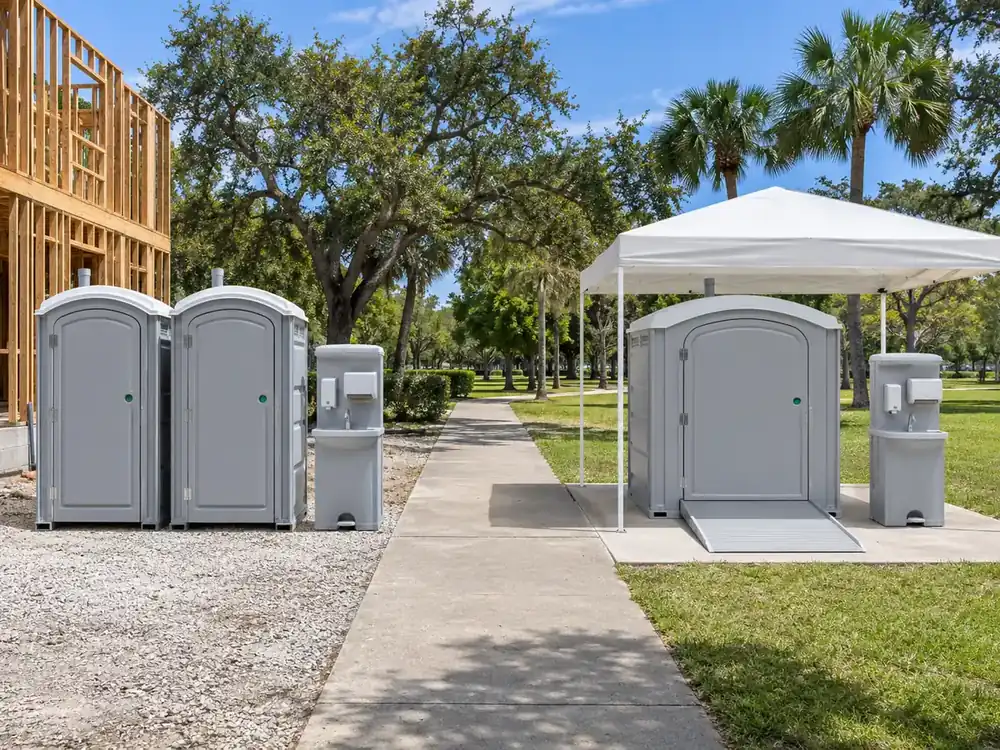
Accessible portable toilet rental involves the approach to the unit as well as the space inside. The ADA Standards address clustered portable units, toilet-room turning space and stable, firm, slip-resistant ground surfaces. Discuss doors, routes and sink access with your service pro and the event's accessibility contact.
For ADA portable toilets at a public gathering, ask the accessibility contact which requirements apply to the proposed arrangement. An ADA portable restroom request should also describe whether guests travel from pavement onto grass. Discuss a usable approach throughout the event, including where a queue will stand. A product description alone does not decide the full site layout.
Gulfport's special-event rules require portable restrooms and hand-washing stations when an open venue has no public restrooms or expected attendance exceeds existing capacity; the city also identifies Florida Department of Health oversight for temporary outdoor-event sanitation. Clearwater's event permit instructions require a site plan showing portable restroom locations and dimensions. Ask the appropriate event office about the planned gathering.
A Season or Months of Continued Use
Continuing use calls for access and service visits to remain part of the schedule. Tell your service pro when crew levels, public attendance or work areas change. Ask what changes to the rental arrangement would follow and who should receive updates from the site contact.
For units used exclusively by construction personnel, the ADA Standards' construction-site exception addresses portable toilets and accessible routes. A public event on the same property needs its own access discussion. Keep crew use and guest use clear when describing the site.
Keep restrooms on firm, level ground away from traffic, equipment, water and overhead lines. Never move, tip, lift or climb on a restroom; request a placement change through your service pro. Your service pro arranges service visits. Discuss rain and storm plans as scheduling questions, including who will communicate changes.
The rules do not select a rental model, set the service-visit schedule or assign the person who sets the unit. Those details belong in the rental discussion. One of our local restroom partners will work through the proposed scope and price with you before arrangements proceed. Call with the location and rental period while the project or event plan develops.